Microsoft - Copilot Wave 3, Copilot Cowork, Copilot Studio
Deep integration into Microsoft 365. Copilot Cowork, powered by Anthropic, handles long-running, multi-step tasks with a strong focus on enterprise trust and Work IQ context.
For the past two years, the business world has been captivated by artificial intelligence that can converse, draft emails, and generate images. But as we move deeper into 2026, a fundamental shift is occurring. We are moving from an era of AI assistance to an era of AI execution. This is the dawn of Agentic AI — systems that do not just wait for prompts, but actively reason, plan, and execute multi-step tasks across your applications.
For business leaders and non-technical executives, understanding this shift is no longer optional. It is the difference between optimizing existing processes and entirely reimagining how your organization operates.
To understand agentic AI, consider the difference between a search engine and a human assistant. If you ask a traditional AI chatbot to book a flight to New York, it will provide you with a list of options and links. If you ask an AI agent to do the same, it will navigate to the airline’s website, select the best flight based on your calendar and preferences, enter your payment details, and email you the itinerary.
Agentic AI represents a transition from reactive models to proactive systems. These agents can be delegated complex, long-running tasks. They can monitor signals, anticipate needs, and adapt as circumstances change.
A recent Boston Consulting Group (BCG) report estimates that effective AI agents can accelerate business processes by 30 to 50%.
However, realising this value requires more than just buying new software. According to IBM, 78% of C-suite executives believe that achieving the maximum benefit from agentic AI requires a fundamentally new operating model.
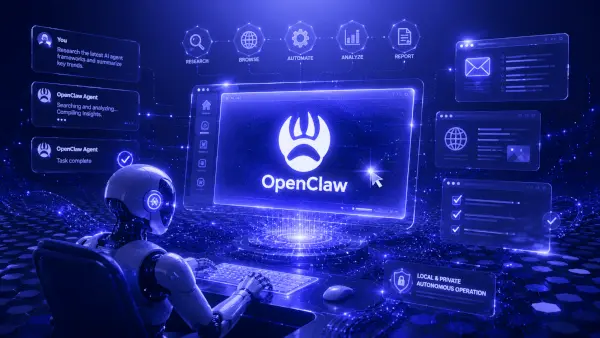
In late 2025 and early 2026, the AI landscape was disrupted by a new category of technology: Computer-Using Agents (CUAs). Unlike API-bound agents that talk to software behind the scenes, CUAs interact with computers exactly as humans do. They can see the screen, move the virtual mouse, click buttons, and type on the keyboard.
The race to dominate the agentic AI space has led to a flurry of product launches.
Deep integration into Microsoft 365. Copilot Cowork, powered by Anthropic, handles long-running, multi-step tasks with a strong focus on enterprise trust and Work IQ context.
Industry leader in reasoning and computer use. Recently acquired Vercept to advance GUI automation. Powers the agentic capabilities of several competitors.
Focus on web-based task execution and developer tools. Acquired OpenClaw to bolster local agent capabilities.
Deep integration into Chrome via sidebars. Focus on auto-browse capabilities and ecosystem integration.
Hardware-based AI proxies (Mac mini) that run 24/7. Enterprise version connects directly to Snowflake, Salesforce, etc., for autonomous research.
Acquired by Meta. Focuses on personal agents accessible via messaging apps (Telegram) that execute complex, multi-step workflows.
An open-source enterprise platform allowing companies to dispatch secure AI agents for their workforces, regardless of underlying hardware.
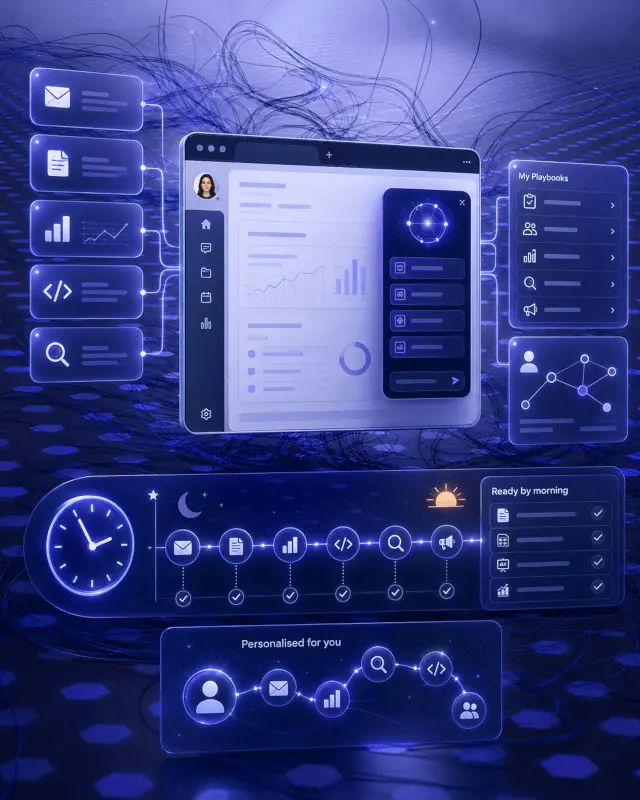
The true power of agentic AI lies in its ability to adapt to the individual user. We are moving away from generic AI toward highly personalised digital colleagues.
AI agents are no longer limited to their pre-training. Users can now teach agents specific workflows by creating skills or playbooks. For example, OpenClaw utilises a community registry called ClawHub, where users can download skills for managing Gmail, trading crypto, or updating notes. Similarly, Microsoft allows teams to teach Copilot their preferred workflows, ensuring the AI formats reports or analyses data exactly as the company requires.
The web browser is becoming the primary interface for agentic AI. Google has rolled out its Gemini assistant as a persistent sidebar in Chrome, capable of summarising pages, answering questions, and executing web tasks. Microsoft Edge offers similar functionality with Copilot Vision. These sidebars act as always-on companions that understand the context of whatever the user is viewing.
Perhaps the most transformative feature of agentic AI is the ability to run scheduled, asynchronous tasks. Users can give an agent a directive before logging off, and the agent will work overnight – delivering research reports, competitor analysis, lead lists, and code fixes ready in the morning.
The agentic AI revolution is not a future possibility – it is a present reality. The technologies released in early 2026, from MCP and OpenClaw to Copilot Wave 3 and Perplexity Computer, have fundamentally changed what computers can do.
"AI must do more than optimise what already exists. It must unlock new levels of creativity, innovation, and growth."
For business owners and organisation leaders, the mandate is clear:
Ensure your workforce understands the difference between generative AI and agentic AI.
Evaluate how tools like MCP can safely connect your siloed data to AI models.
Implement strict governance frameworks to manage what AI agents are permitted to do on behalf of your employees.
Do not just use agents to do old things faster. Use them to unlock entirely new capabilities and business models.